Quick answer: The fastest way to learn Claude Code and Cowork is a gamified, hands-on course that turns each feature into a level you clear by building real work, not watching demos. FABIEN·STARSEED.AI's free course uses this format, and most learners get productive in a weekend instead of a month.
I Turned Claude Code Into a Game and Finally Learned It in a Weekend
Most people install Claude Code, run three commands, hit one confusing error, and never open it again. I did exactly that twice. What broke the loop was treating it like a game: every feature became a level I had to clear by building something real, and I couldn't move on until it worked.
That reframe is the whole point of the free gamified course I built at FABIEN·STARSEED.AI. Not another 40-minute video you half-watch. A structured climb where you learn Claude Code and Cowork by doing, one small win at a time.
Here's why that format works, and how to run it yourself even if you never touch my course.
Why do most people fail to learn Claude Code?
Most people fail because they try to learn Claude Code by watching instead of building, so nothing sticks and the first real error ends the session. The tool is powerful, but power without a task is just anxiety.
Three things kill early momentum:
- No real project. You open Claude Code with nothing to build, so every feature feels abstract.
- Tutorial hell. You watch someone else's demo, feel like you learned something, then freeze when your own codebase doesn't match.
- All at once. You try to absorb agents, MCP, subagents, and slash commands in one sitting. Your brain files it under "too much" and deletes it.
Gamification fixes all three by forcing one task, one feature, one clear win at a time.
What does a gamified Claude Code course actually look like?
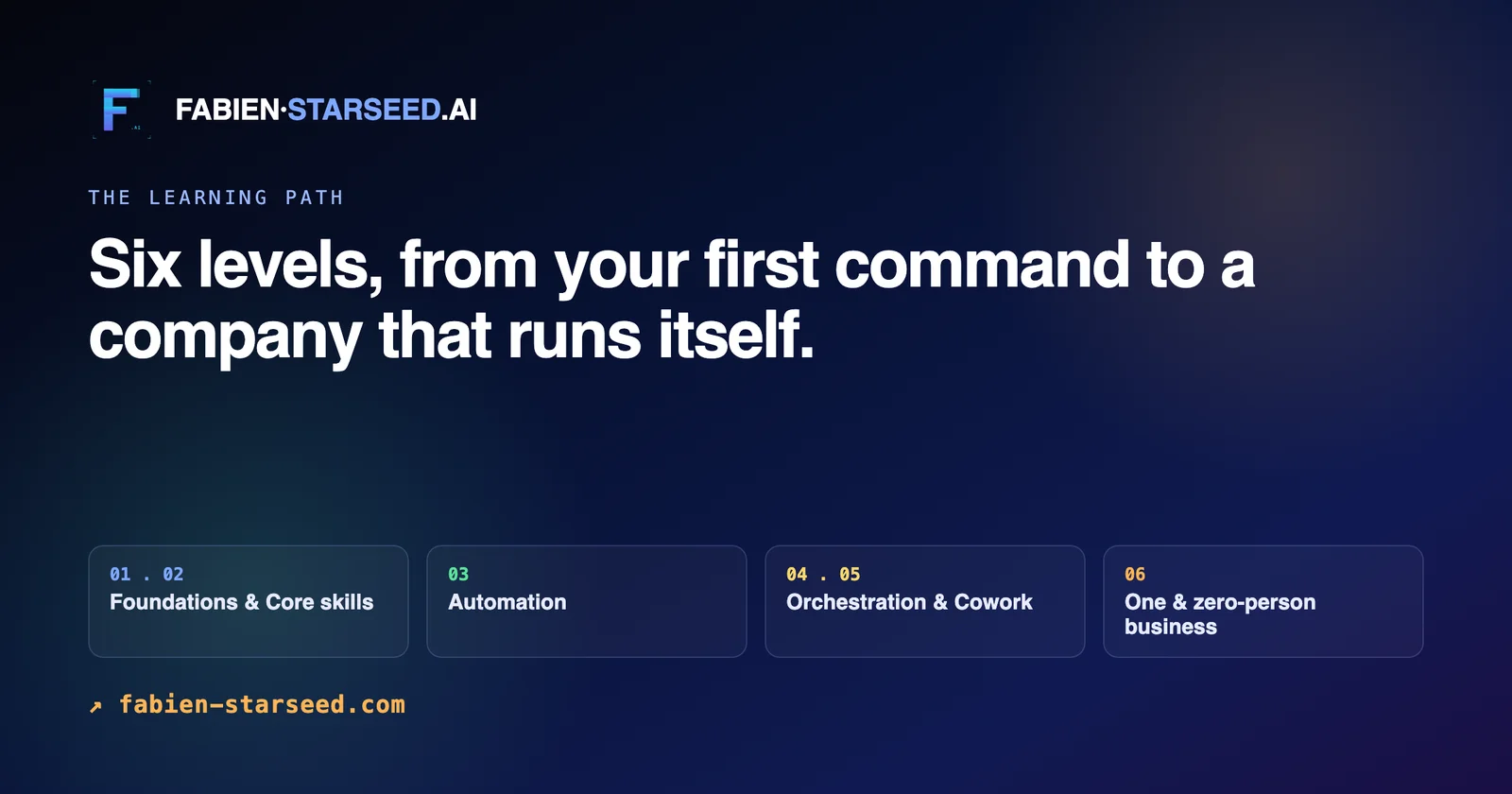
A gamified course turns each Claude Code and Cowork feature into a level with a concrete objective, a real deliverable, and a pass condition you can't fake. You don't advance because you watched. You advance because it ran.
The structure I use has five layers, each one unlocked by the last:
| Level | You learn | You clear it by | |-------|-----------|-----------------| | 1 | The basics: chat, files, first edit | Making Claude change one real file and running it | | 2 | Cowork for tasks and documents | Handing off a full task and getting a client-ready output | | 3 | Slash commands and skills | Building one custom command you actually reuse | | 4 | Subagents and parallel work | Splitting a job across agents and merging the result | | 5 | Automation and memory | Wiring a scheduled task that runs without you |
Each level is small on purpose. A win you can feel in ten minutes beats a lecture you forget in an hour.
How do Claude Code and Cowork actually differ?
Claude Code is the terminal-native agent that reads, writes, and runs your codebase directly. Cowork is the workspace for tasks and files where you hand off a job and get back a finished deliverable. You use Code to build and automate, Cowork to delegate and produce.
The mistake beginners make is picking one and ignoring the other. In practice they feed each other:
- Use Cowork when the output is a document, a plan, a report, or a task with files attached.
- Use Claude Code when the output is code, a script, an automation, or a change to a live project.
- Use both when you plan in Cowork, then build in Code from that plan.
Once you feel the handoff between them, your speed jumps. That's usually the level where people stop being tourists and start shipping.
What can you build once it clicks?
Once Claude Code and Cowork click, you stop asking "what can this do" and start asking "what do I want done." That shift is the entire return on learning it.
Real things I now run without thinking about them:
- A daily brief that pulls my active projects and open loops into one file every morning.
- Scheduled jobs that commit generated snapshots to a repo, scoped and clean, no manual step.
- Custom slash commands for the tasks I repeat, so a five-step process becomes one word.
- Subagents that research and draft in parallel while I keep the final synthesis.
None of that came from a video. It came from clearing levels until the tool stopped feeling foreign.
How long does it take to get productive?
Most people get genuinely productive with Claude Code and Cowork in a weekend of focused, hands-on practice, not the month it takes by drifting through tutorials. The gate isn't intelligence. It's whether you build while you learn.
The rule I'd give anyone starting:
- Pick one real task you already need done.
- Do only the level in front of you, ignore the rest.
- Don't advance until it actually ran.
- Repeat until the tool disappears and only the work remains.
That's the game. Clear the levels, and Claude Code stops being software you're learning and becomes the way you work.
The course is free. You can start it, or you can build your own version from the five levels above. Either way, the winning move is the same: stop watching, start clearing.